
FoxESS EV Charger Australia : The Complete Australian Buyer's Guide (2026)
Here’s a situation that’s happening to thousands of Australian households right now. You’ve got a 6.6kW solar system on the roof, it’s generating more power than your home needs between 10am and 3pm, and that surplus is getting exported to the grid for around 3 to 5 cents per kilowatt-hour. Then, at 11pm, you plug in your EV and charge it from the grid at 35 cents per kilowatt-hour. That’s a ten-times markup on energy you already generated.
A smart EV charger breaks that cycle. Instead of exporting your solar surplus and buying it back at night, a solar-integrated charger diverts that surplus directly into your car during the day. You charge for next to nothing, and your feed-in tariff stays where it belongs as a small bonus, not your main strategy.
The FoxESS EV Charger (A-Series) is one of the more interesting options for Australian solar homes in 2026 particularly if you’re already using a FoxESS inverter or battery. But even if you’re not, it’s worth a close look. This guide covers everything: how it works, what it costs, how it stacks up against the competition, whether it suits the Australian climate, and how to take advantage of government rebates when you buy.
What Is the FoxESS EV Charger?
FoxESS is a Chinese energy technology company with a growing presence in Australia, best known for their hybrid inverters and battery storage systems. Their A-Series EV charger is the residential and light-commercial charging solution in their lineup — designed to work seamlessly with their solar and battery ecosystem, but also usable as a standalone smart charger.
There are two models to know about:
- 7kW single-phase —
- The right choice for most Australian homes. Single-phase power is standard in the majority of residential properties, and 7kW is enough to add roughly 40km of range per hour of charging. Plug in for 3–4 hours during a sunny afternoon using surplus solar, and you’ve covered a typical day’s driving for free.
- 22kW three-phase —
- For homes or small businesses already on three-phase power. Charges roughly three times faster, which matters more for commercial use or households with two EVs sharing one charger.
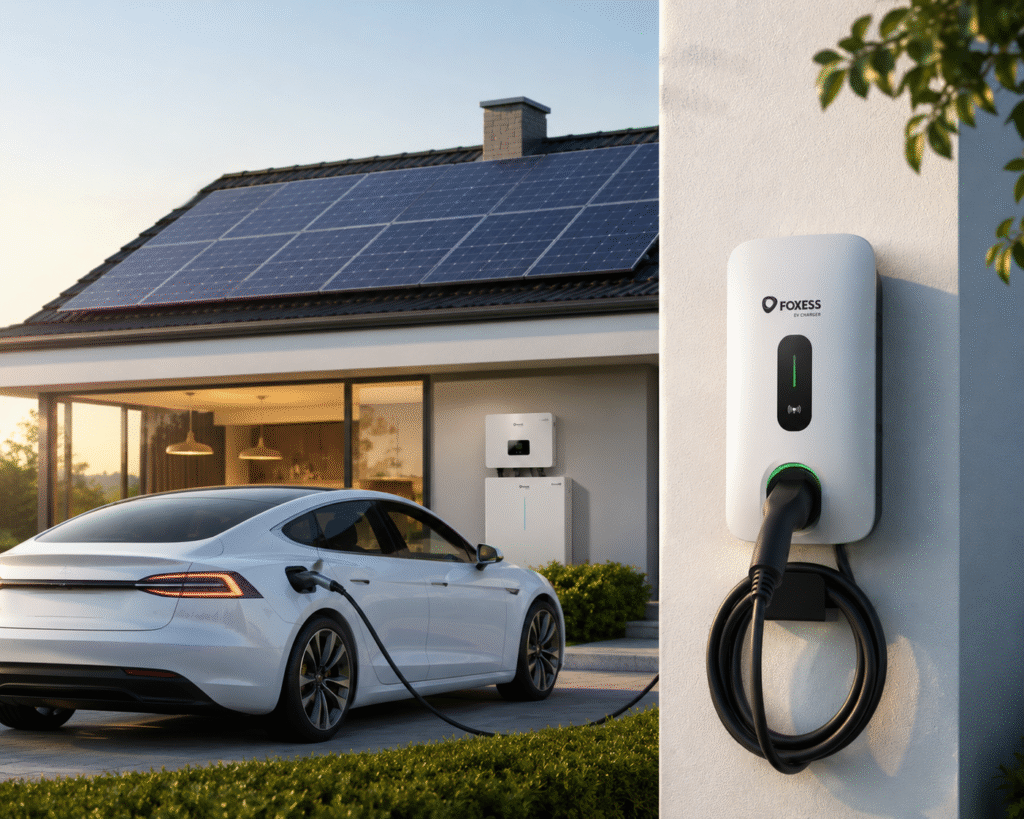
A-Series Specifications at a Glance
Specification | 7kW Model | 22kW Model |
Output power | 7kW | 22kW |
Phases | Single-phase | Three-phase |
Cable (tethered) | 6 metres | 6 metres |
Connector type | Type 2 | Type 2 |
IP rating | IP65 | IP65 |
Solar integration | Yes (PV Linkage) | Yes (PV Linkage) |
Load balancing | Yes | Yes |
App control | Yes (FoxESS app) | Yes (FoxESS app) |
OCPP | Yes | Yes |
Price (approx.) | ~$1,280 AUD | ~$1,780 AUD |
Warranty | 2 years | 2 years |
Quick note on the tethered cable:
6 metres is a solid length for most garage setups. If your switchboard and parking spot are far apart, confirm the cable can reach before purchasing. Competitors like Zappi offer 6.5m and Enphase goes to 7.6m if you need extra length.
PV Linkage Mode: Charging with your own sunshine
FoxESS calls their solar diversion feature PV Linkage (Photovoltaic Linkage). Here’s the logic in plain English:
- Your solar panels generate power throughout the day.
- Your home uses some of that power for appliances, lights, hot water, and so on.
- Whatever’s left over (the surplus) would normally be exported to the grid at a low feed-in rate.
- With PV Linkage active, the charger monitors your home’s net energy flow in real time via a CT clamp on your main switchboard.
- When it detects surplus solar, it automatically starts pushing that power into your EV instead of exporting it.
- If your solar drops (a cloud passes, or it’s late afternoon), the charger adjusts the charge rate down accordingly, or pauses completely if you’ve set it to solar-only mode.
What about when there's not enough solar?
You’ve got two options, and you set this in the FoxESS app:
- Solar-only mode:
- Charge only from surplus solar. The charger pauses when surplus drops below the minimum needed to charge. Your grid bill stays at zero, but charging is slower and weather-dependent.
- Hybrid mode:
- Use solar where available and top up from the grid to maintain a minimum charge rate. You might pay a little for grid power, but your car always makes progress.
Most households end up using hybrid mode on weekdays (car needs to be ready by 7am) and solar-only mode on weekends when there’s no time pressure. Both are configurable in the app.
Load Balancing — the feature that protects your switchboard
This one’s underexplained everywhere. Load balancing means the charger talks to your switchboard (via the CT clamp) and monitors how much power the rest of your home is drawing. If you turn on the oven, the ducted air conditioning, and a pool pump simultaneously, the charger automatically reduces its output to make sure you don’t trip your main breaker.
Without load balancing, a 7kW charger running flat out can push a busy household over the safe amperage limit of a 63-amp single-phase main fuse — especially in older homes. With load balancing, the charger backs off in real time, then ramps back up when the demand drops. It’s a small feature that prevents a genuinely frustrating problem.
FoxESS EV Charger vs. the Competition
Let’s be direct. The FoxESS A-Series is a solid mid-range charger — but it’s not the only smart solar charger in Australia, and some competitors have genuine advantages. Here’s the honest picture.
Charger | Price (AUD) | Solar Mode | OCPP | IP Rating | Warranty |
FoxESS A-Series 7kW | ~$1,280 | Yes (PV Link) | Yes | IP65 | 2 years |
Zappi V2 | ~$1,595 | Yes (3 modes) | No | IP65 | 3 years |
Evnex E2 Plus | ~$1,299 | Yes | Yes (closed) | IP54 | 3 years |
Wallbox Pulsar Plus | ~$1,100 | Limited | Yes | IP54 | 2 years |
Is the FoxESS EV Charger Suited to Australian Conditions?
Short answer: yes, with a few things worth knowing before you mount it outdoors.
- IP65 rating:
- IP65 means it’s fully protected against dust and can handle jets of water from any direction. That’s fine for Australian outdoor installations in covered areas — under a pergola, carport, or garage wall. It’s a solid rating, matching Zappi’s and better than Evnex and Wallbox (both IP54).
- Operating temperature:
- This matters in Queensland, WA, and the Northern Territory. Always verify the A-Series datasheet for the confirmed operating temperature range with your installer. Compare this to Zappi’s 40°C ceiling, which is a real limitation in those states. FoxESS’s spec is worth confirming before purchase if you’re in a hot climate.
- Electrical compliance:
- Any EV charger installed in Australia must comply with AS/NZS 3000 (the Australian/New Zealand Wiring Rules). Your licensed electrician will ensure this — it’s not optional. Make sure your installer is familiar with FoxESS products specifically, as the CT clamp configuration for PV Linkage does require a bit of setup knowledge.
Installation: What's Involved and What It Actually Costs
The charger itself is one cost. Installation is another — and it varies more than most people expect.
Single-phase vs. three-phase: what you need to know first
Before you order anything, find out what power supply your home has:
- Single-phase (most Australian homes):
- You can run the 7kW FoxESS model. Standard 63-amp main fuse gives you enough capacity alongside normal household loads in most cases. Installation is straightforward.
- Three-phase:
- The 22kW model requires three-phase power. Many newer homes and some older metro properties have it — check your meter box or ask your electrician. If you don’t have three-phase and want it, upgrading can cost $2,000 to $8,000 depending on your location and how far your property is from the street infrastructure.
Typical installation costs
- Basic installation (charger near switchboard, no upgrades needed): $400 – $700
- Installation with cable run through walls or ceiling cavity: $700 – $1,100
- Installation requiring switchboard upgrade: add $800 – $1,500
- Installation with CT clamp setup for PV Linkage: usually included in the above, but confirm with your installer
Total out-of-pocket for the 7kW FoxESS with a standard install: roughly $1,700 to $2,100 all up, before any rebates.
Australian Rebates and Incentives You Can Use Right Now
The rebate landscape has changed a lot in 2025–2026. Many of the headline state rebates on EV purchases have closed. But there are still meaningful incentives worth stacking — especially for the charger hardware itself.
ACT — Most generous remaining scheme
Sustainable Household Scheme: Interest-free loans from $2,000 up to $15,000 for the purchase of ZEVs and household EV charging infrastructure, repayable over up to 10 years. This is one of the best remaining schemes in the country — essentially free financing for your charger and installation.
Tasmania — $1,000 EV charger grant
Electric Vehicle Charger Grant Scheme: A $1,000 grant towards the cost of a residential EV charger for eligible owners. Directly applicable to the FoxESS A-Series purchase. Check current eligibility criteria on the Tasmanian Government website as availability is limited.
Is the FoxESS EV Charger Worth the Investment? Let's Run the Numbers
Here’s the maths for a typical Australian household, so you can decide whether this makes sense for your situation.
Scenario: solar household in Sydney
- Solar system: 6.6kW rooftop
- EV: drives 60km per day, needs roughly 12kWh of charge
- Grid electricity rate: 33c/kWh
- Solar feed-in tariff: 5c/kWh
- Charging schedule: 5 days per week
Without a smart charger (charging from grid overnight)
12kWh × 33c × 5 days × 52 weeks = ~$1,030/year in electricity costs just for the car.
With FoxESS A-Series in PV Linkage mode
Assuming 65% of charging covered by surplus solar (conservative for a 6.6kW system in Sydney):
- Solar-covered charging: 65% of 12kWh = 7.8kWh — cost is effectively zero (vs. exporting at 5c)
- Grid top-up: 35% of 12kWh = 4.2kWh × 33c × 5 days × 52 weeks = ~$360/year
Annual saving: ~$670 compared to charging entirely from the grid.
Charger cost ($1,280) + standard install ($600) = $1,880 total. At $670 saved per year, payback period: approximately 2.8 years. After that, the savings are pure benefit for the remaining life of the charger.
These numbers will vary depending on your solar system size, how much you drive, your electricity rate, and your local climate. But the general direction is clear: for a solar household, the smart charger pays for itself well within a typical EV ownership period.